⚡
Convenient peptide
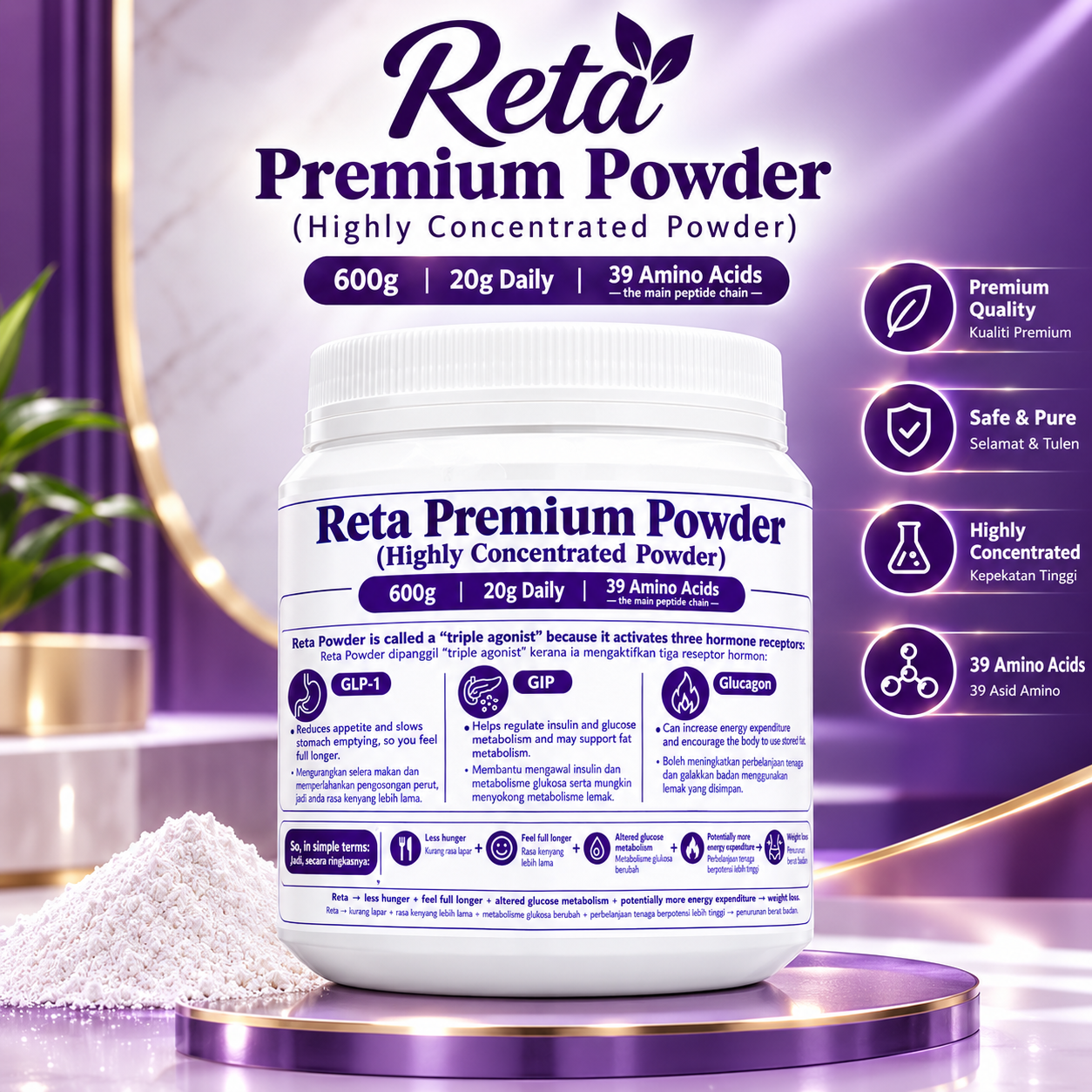
GLP-1 → reduces appetite and slows stomach emptying, so you feel full longer.
Premium Reta Powder. Smooth, convenient and designed to make hitting your daily protein target easier.
Reta Powder is a convenient source of high-quality protein. It can help you reach your daily protein intake alongside a balanced diet and training routine.
GLP-1 → reduces appetite and slows stomach emptying, so you feel full longer.
GIP → helps regulate insulin and glucose metabolism and may support fat metabolism.
Glucagon → can increase energy expenditure and encourage the body to use stored fat.
Reta → less hunger + feel full longer + altered glucose metabolism + potentially more energy expenditure → weight loss. Clinical trials have shown substantial weight loss, with one Phase 3 result reporting about 28% average body-weight loss at 12 weeks with regular intake.
There is no single required time. Many people take it as a breakfast in the morning
Mix the recommended serving with warm water, add 2 or 3 half boiled eggs, mixed well.Drink.
For most healthy adults, reta powder can be part of a balanced diet. Follow the product serving guidance.
No. but it's help to get balanced diet.
1 Tyrosine (Y) Eggs, dairy, chicken, fish, soy 3 Glutamine (Q) Meat, eggs, dairy, soy 4 Glycine (G) Meat, fish, gelatin, legumes 5 Threonine (T) Eggs, dairy, meat, soy 6 Phenylalanine (F) Meat, eggs, dairy, soy 7 Threonine (T) Eggs, dairy, meat, soy 8 Serine (S) Eggs, soy, meat, dairy 9 Aspartic acid (D) Meat, eggs, soy, legumes 10 Tyrosine (Y) Eggs, dairy, meat, soy 11 Serine (S) Eggs, soy, meat 12 Isoleucine (I) Eggs, meat, fish, dairy, soy 13 α-Methyl-leucine 14 Leucine (L) Meat, dairy, eggs, soy 15 Aspartic acid (D) Meat, eggs, soy 16 Lysine (K) Meat, fish, eggs, dairy, legumes 17 Lysine (K) Meat, fish, eggs, dairy, legumes 18 Alanine (A) Meat, fish, eggs, legumes 19 Glutamine (Q) Meat, eggs, dairy, soy 21 Alanine (A) Meat, eggs, legumes 22 Phenylalanine (F) Meat, eggs, dairy, soy 23 Isoleucine (I) Meat, eggs, dairy, soy 24 Glutamic acid (E) Meat, fish, dairy, soy 25 Tyrosine (Y) Eggs, dairy, meat, soy 26 Leucine (L) Meat, dairy, eggs, soy 27 Leucine (L) Meat, dairy, eggs, soy 28 Glutamic acid (E) Meat, fish, dairy, soy 29 Glycine (G) Meat, gelatin, fish, legumes 30 Glycine (G) Meat, gelatin, fish, legumes 31 Proline (P) Meat, dairy, eggs, legumes 32 Serine (S) Eggs, soy, meat 33 Serine (S) Eggs, soy, meat 34 Glycine (G) Meat, gelatin, fish 35 Alanine (A) Meat, fish, eggs, legumes 36 Proline (P) Meat, dairy, eggs 37 Proline (P) Meat, dairy, eggs 38 Proline (P) Meat, dairy, eggs 39 Serine (S) Eggs, soy, meat
| Foods | Why |
| 🍟 **Deep-fried foods** | High fat can worsen nausea and stomach discomfort |
| 🍔 **Fast food** | Usually high in fat, calories and salt |
| 🍕 **Very greasy meals** | Can be difficult to tolerate |
| 🍰 **Large amounts of sweets** | Easy to consume excess calories |
| 🥤 **Sugary drinks/soft drinks** | Lots of calories without much nutrition |
| 🧋 **Very sweet milk tea/bubble tea** | High sugar and calories |
| 🌶️ **Very spicy food** | May aggravate reflux/nausea in some people |
| 🍺 **Alcohol** | Can worsen dehydration and GI symptoms |
| 🍽️ **Very large meals** | More likely to cause uncomfortable fullness/nausea |
| 🥓 **Processed fatty meats** | High fat and calories; limit regularly |
| 🥤 **Carbonated drinks** | May increase bloating for some people |
First 1–2 weeks: Some people notice reduced appetite or feeling full sooner. Weight change may be small. Around 4–8 weeks: You may start noticing a clearer change on the scale and in waist measurements. Around 3 months: Changes can become more noticeable in body shape and clothing fit.<> 6–12+ months: Clinical trials have shown substantial average weight loss over longer periods, but the amount varies considerably between people.